

For years, political leaders have insisted that Palestine is a foreign policy issue with little impact on local elections, but the latest election results in England suggest otherwise.
New data from local elections held in May found that candidates who publicly committed to supporting Palestinian rights outperformed candidates from nearly every major political party. The only group with a higher success rate was Reform UK.
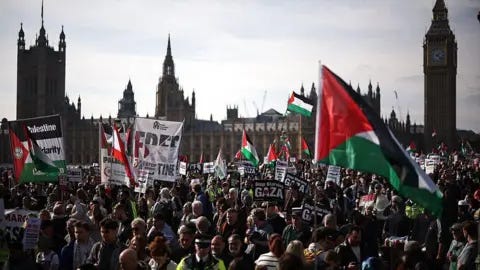
Candidates who signed the Palestine Solidarity Campaign’s “Pledge for Palestine” won roughly 27% of the seats they contested. By comparison, Labour candidates won about 22% of the seats they ran for, while Liberal Democrats won 21%. The pledge requested candidates to support Palestinian rights, oppose council investments linked to companies involved in Israel’s occupation, and push local governments to avoid complicity in violations of international law.
More than 2,000 Green Party candidates signed the pledge, along with hundreds of Labour, independent, Liberal Democrat, and Conservative candidates. The results were especially notable in cities with large student populations, younger voters, and significant Muslim and ethnic minority communities.
In London, Green candidates who supported the pledge helped secure major gains in boroughs like Hackney and Haringey. Similar victories were seen among Green and independent candidates in cities such as Birmingham and Bradford. The outcome challenges a common assumption in British politics: that voters care primarily about domestic concerns and leave foreign policy at the ballot box.
Instead, Palestine appears to be emerging as a mobilizing issue capable of influencing local elections, shaping voter turnout, and helping determine who wins municipal power. Activists behind the campaign argue that the results demonstrate the effectiveness of grassroots organizing. They also believe the election offers a warning to politicians who have dismissed public concern over Gaza and British support for Israel.
The significance extends beyond symbolic politics. Local councils oversee billions of pounds in pension funds, procurement contracts, and public investments. Campaigners increasingly view those financial decisions as tools that can either support or challenge companies linked to Israel’s occupation of Palestinian territory.
With the next general election approaching, one thing is becoming harder for Britain’s political establishment to ignore:
For a growing number of voters, Palestine is no longer just a foreign policy issue; it’s becoming an electoral issue.
Ariana, this is the best news in a while. I only hope that this attitude spreads. Like wildfire! Thanks for this one.
Hopefully they can help reverse that stupid ruling on Cenk and Hasan.